Plan Your Data Platform
Build a unified, real-time data foundation that connects all your systems, breaks down silos, and delivers consistent, high-quality data to power your business. This guide explains why you need an Operational Data Hub (ODH) and how to plan and implement one step by step.
Why Plan Your Data Platform
As businesses grow, data often ends up scattered across siloed systems—making it hard to share, analyze, or act on in real time.
In ecommerce or fintech, functions like fraud detection, inventory checks, or customer segmentation all depend on fast, reliable data. But when systems are fragmented, timely decision-making becomes difficult.
Traditional data warehouses help with historical analysis but fall short for real-time needs:
- T+1 latency isn’t fast enough
- High complexity adds engineering burden
- Hard to adapt as needs change
Some teams try building real-time pipelines with stream tools, but these often come with high complexity and steep learning curves.
A better solution is an Operational Data Hub (ODH)—a lightweight, real-time layer that unifies data across systems and makes it instantly usable across teams and applications.
What is an Operational Data Hub (ODH)?
An Operational Data Hub is a real-time data integration and delivery layer that sits between your source systems and consuming applications. It's designed to solve fragmented data landscapes, reduce integration complexity, and deliver consistent, standardized data in real time.
At its core, an ODH is about connecting, transforming, and delivering data:
- Connect: Seamlessly integrate diverse data sources—databases, APIs, event streams—without requiring major system changes.
- Transform: Clean, standardize, and model data into consistent formats and business entities that everyone can understand.
- Deliver: Make high-quality, up-to-date data available to consuming systems and teams via APIs or downstream databases.
With an ODH, you move from siloed, hard-to-manage data flows to a single, unified, reusable data service that powers real-time operations and decision-making.
Tapdata's ODH design breaks this journey into clear, manageable layers:
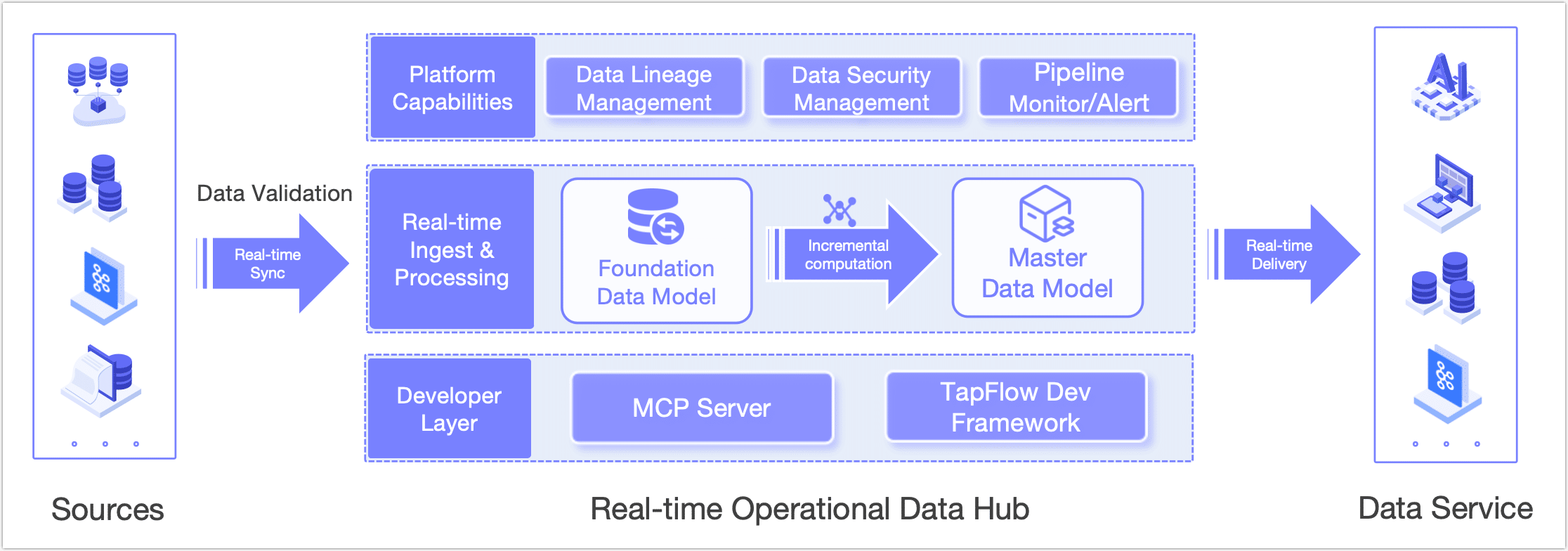
| Layer | Purpose |
|---|---|
| Source Data Layer | Connect to and abstract data from all business systems and sources, without disrupting existing operations. |
| Platform Cache (FDM) | Use real-time change data capture (CDC) to mirror source tables safely, reducing load on critical systems. |
| Curated Data Layer (MDM) | Transform, clean, and model data into standardized business entities and wide tables for consistent consumption. |
Delivering Real-time Data to Business Systems
Once your data is processed and modeled in the MDM layer, you can deliver it to downstream business systems through API Services, Data Replication, Data Transformation, Event Streaming, or Direct Database Access.
This approach aligns with best practices for Master Data Management (MDM) as defined by Gartner: enabling IT and business teams to work together to ensure consistency, accuracy, governance, and shared understanding of core business data.
How to Plan Your Data Platform
Once you understand the why and what of an ODH, the next question is: How do you actually build it?
Below is a practical roadmap, based on proven best practices and real-world implementations, to help you plan and implement your own operational data platform.
1. Define Goals and Priorities
Start with business needs, not just technical architecture.
- Identify critical use cases (e.g., real-time fraud scoring, customer segmentation).
- List the core data assets required to enable these scenarios.
2. Audit Existing Data Assets
- Map out data sources, formats, and update frequencies.
- Document owners and integration points.
- Build an asset inventory or data catalog to clarify what's available.
3. Establish Standards and Governance
-
Define unified data models and clear, agreed-upon metrics.
-
Standardize naming conventions and security classifications.
Examples:
FDM_SourceSystem_TableNamefor raw mirrorsMDM_Domain_BusinessLogicfor processed wide tablesADM_Domain_Metric_Frequencyfor business-facing aggregates
-
Document data definitions, lineage, and ownership so everyone understands what's being delivered.
4. Design and Build Data Pipelines
Follow a layered approach:
- FDM: Mirror source data in real time without overloading production systems.
- MDM: Clean, enrich, and model data into consistent, business-friendly forms.
- ADM: Create ready-to-use data services or tables tailored to specific use cases.
Example:
For fraud risk, replicate transactions and user profiles into FDM. Merge and enrich them in MDM to create a real-time user risk profile table for the scoring engine.
5. Deploy Monitoring and Quality Checks
- Set up automated monitoring and alerts for data pipelines.
- Conduct regular quality reviews to ensure data freshness, accuracy, and availability.
6. Iterate and Improve
- Start with a pilot project for one high-impact use case.
- Gather feedback, improve models and processes.
- Gradually scale to additional teams and data domains.
By following this approach, you can turn fragmented, hard-to-use data into a single, standardized, reusable data service that fuels real-time decision-making and enables your entire organization to move faster and smarter.